Manejo hemodinámico y estrategias individualizadas de fluidoterapia en cirugía de contorno corporal: Revisión narrativa
CRITICAL CARE & EMERGENGY MEDICINE VOL. 4
Hemodynamic management and individualized fluid therapy strategies in body contouring surgery: A narrative review

- 2 agosto, 2025
- Revisión narrativa, Volumen 4.
Sergio Soto-Hopkins 1, Lizeth Rojas Corona 2, Fernando Jaziel López Pérez 3, Lucía Íñiguez 4, José Antonio Sánchez López 5.
1 Anestesiólogo Cardiovascular TJ Plast Centro de Cirugía Plástica. Tijuana, México.
2 Anestesiólogo Intensivista Hospital Ángeles LindaVista. Ciudad de México.
3 Urgencias Médico Quirúrgicas Hospital General de Zona 1. Saltillo, Coahuila.
4 Anestesiólogo Cardiovascular Espino Plastic Surgery. Tijuana, México.
5 Anestesiólogo Cardiovascular Hospital de Cardiología Centro Médico Nacional Siglo XXI. Ciudad de México.
Abstract
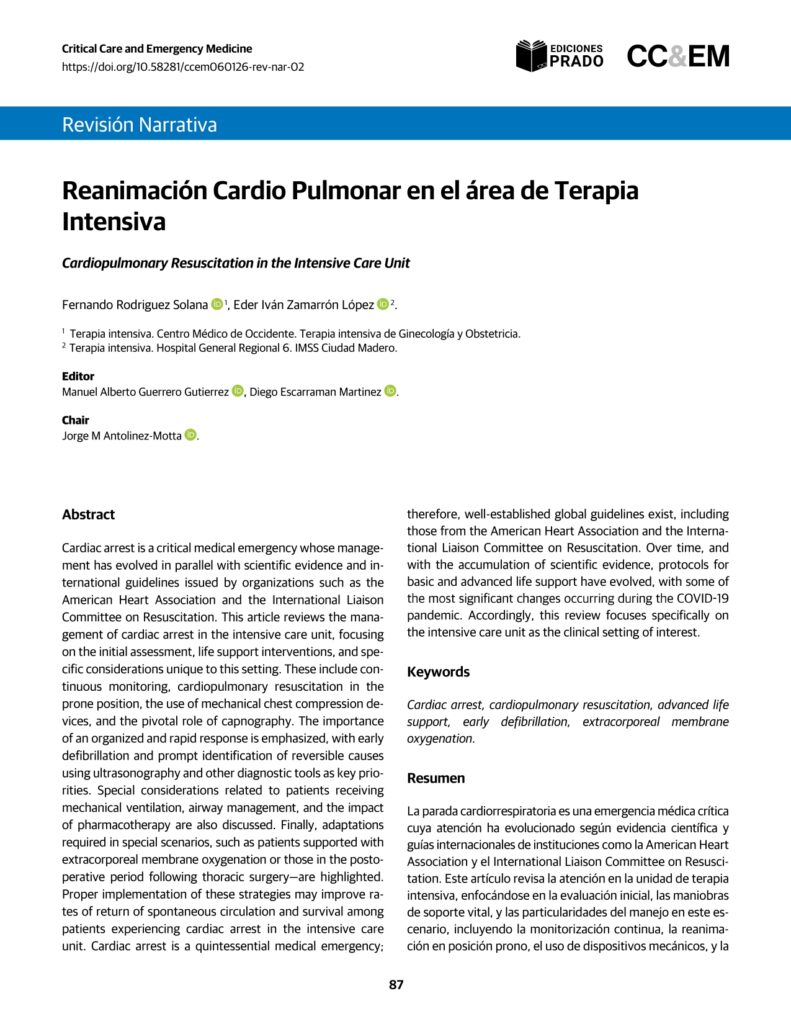
Liposuction is the most performed cosmetic procedure worldwide and, in its large-volume form, presents significant perioperative hemodynamic challenges. This narrative review outlines the technical evolution of liposuction from early curettage to modern tumescent techniques highlighting systemic effects of subcutaneous adrenaline infiltration such as post-infusion vasodilation and hypotension. The need for individualized intraoperative fluid therapy is emphasized, transitioning from fixed-volume approaches to strategies guided by dynamic variables such as the respiratory variation in carotid peak velocity, descending aortic flow variation, and the velocity-time integral of the left ventricular outflow tract. These methods, using carotid Doppler and suprasternal echocardiography, allow for accurate assessment of fluid responsiveness while reducing fluid overload risk.
Additionally, the concept of fluid tolerance—defined as the patient’s ability to receive intravenous fluids without triggering or worsening organ dysfunction is addressed. The integration of the Venous Excess Ultrasound Score is proposed to assess venous congestion non-invasively, supporting safe and tailored fluid management strategies in body contouring procedures.
Resumen
La liposucción es el procedimiento estético más realizado a nivel global y, en su forma de gran volumen, conlleva desafíos relevantes en el manejo hemodinámico perioperatorio. Este artículo revisa la evolución técnica del procedimiento, desde su inicio con curetaje hasta la técnica tumescente moderna, destacando los efectos fisiológicos de la infiltración con adrenalina, como vasodilatación postoperatoria e hipotensión. Se discute la necesidad de individualizar la fluidoterapia intraoperatoria, pasando de fórmulas fijas hacia estrategias guiadas por variables dinámicas como la variación respiratoria de la velocidad pico carotídea, la variación respiratoria de la velocidad pico en la aorta descendente o la integral de velocidad-tiempo del tracto de salida del ventrículo izquierdo. A través de herramientas accesibles como el Doppler carotídeo y la ecografía desde la ventana supraesternal, es posible predecir la respuesta a líquidos con mayor precisión, minimizando riesgos de sobrecarga.
Además, se enfatiza la importancia del concepto de “tolerancia a líquidos”, evaluando no solo si el paciente responde a fluidos, sino si puede tolerarlos sin inducir disfunción orgánica. Finalmente, se propone integrar la evaluación ecográfica de la congestión venosa sistémica mediante el puntaje Venous Excess Ultrasound Score, permitiendo un enfoque integral, no invasivo y personalizado del manejo de líquidos en este tipo de procedimientos.
Keywords
Liposuction, fluid therapy, fluid responsiveness, fluid tolerance, Doppler ultrasound, VExUS.
Biografias de autores
Sergio Soto-Hopkins
Anestesiólogo Cardiovascular TJ Plast Centro de Cirugía Plástica. Tijuana, México.
Lizeth Rojas Corona
Anestesiólogo Intensivista Hospital Ángeles LindaVista. Ciudad de México.
Fernando Jaziel López Pérez
Urgencias Médico Quirúrgicas Hospital General de Zona 1. Saltillo, Coahuila.
Lucía Íñiguez
Anestesiólogo Cardiovascular Espino Plastic Surgery. Tijuana, México
José Antonio Sánchez López
Anestesiólogo Cardiovascular Hospital de Cardiología Centro Médico Nacional Siglo XXI. Ciudad de México.
Referencias
- International Society of Aesthetic Plastic Surgery. ISAPS Global Survey 2023. [Internet]. 2023 [citado 28 de mayo de 2025]. https://www.isaps.org/media/rxnfqibn/isaps-global-survey_2023.pdf
- Chittoria RK, Singh BK. History of liposuction for body contouring. CosmoDerma. 2022;2:110. doi:10.25259/CSDM_119_2022
- Mendez BM, Coleman JE, Kenkel JM. Optimizing patient outcomes and safety with liposuction. Aesthet Surg J. 2019;39(1):66–82. doi:10.1093/asj/sjy151
- Chittoria RK, Singh PBK. Indications and techniques of liposuction. CosmoDerma. 2022;2:109. doi:10.25259/CSDM_124_2022
- Fodor PB. Reflections on lipoplasty: history and personal experience. Aesthet Surg J. 2009;29(3):226–31. doi:10.1016/j.asj.2009.02.0076.
- Brown SA, Lipschitz AH, Kenkel JM, Sorokin E, Shepherd G, Grebe S, et al. Pharmacokinetics and safety of epinephrine use in liposuction. Plast Reconstr Surg. 2004;114(3):756–63. doi:10.1097/01.prs.0000131021.17800.be
- Aslani A, Waked K, Kuenlen A. Fluid balance after tumescent infiltration: a practical guideline to avoid dilution anemia in circumferential liposuction based on a prospective single-center study. Aesthet Surg J. 2023;43(5):NP337–45. doi:10.1093/asj/sjac349
- Mortada H, Alshenaifi SA, Samawi HA, Marzoug MM, Alhumsi T, Alaithan B. The safety of large-amount liposuction: a retrospective analysis of 28 cases. J Cutan Aesthet Surg. 2023;16(3):227–31. doi:10.4103/JCAS.JCAS_59_22
- Chow I, Alghoul MS, Khavanin N, Hanwright PJ, Mayer KE, Hume KM, et al. Is there a safe lipoaspirate volume? A risk assessment model of liposuction volume as a function of body mass index. Plast Reconstr Surg. 2015;136(3):474–83. doi:10.1097/PRS.0000000000001498
- Rohrich RJ, Leedy JE, Swamy R, Brown SA, Coleman J. Fluid resuscitation in liposuction: a retrospective review of 89 consecutive patients. Plast Reconstr Surg. 2006;117(2):431–5. doi:10.1097/01.prs.0000201451.64344.1b
- Yamashita H, Shibuya I, Tanaka K, Harayama N, Inoue U, Kabashima N, et al. The mechanism of inhibitory actions of propofol on rat supraoptic magnocellular neurons. Anesth Analg. 1999;89(5):1307–13. doi:10.1097/00000539-199911000-00034.
- Morita K, Otsuka F, Ogura T, Takeuchi M, Mizobuchi S, Yamauchi T, et al. Sevoflurane anaesthesia causes a transient decrease in aquaporin-2 and impairment of urine concentration. Br J Anaesth. 1999;83(5):734–9. doi:10.1093/bja/83.5.734.
- Ostermann M, Auzinger G, Grocott M y cols. POQI XI Investigators. Perioperative fluid management: evidence-based consensus recommendations from the international multidisciplinary PeriOperative Quality Initiative. Br J Anaesth. 2024 Dec;133(6):1263-1275. doi: 10.1016/j.bja.2024.07.038.
- Kalantari K, Chang JN, Ronco C, Rosner MH. Assessment of intravascular volume status and volume responsiveness in critically ill patients. Kidney Int. 2013 Jun;83(6):1017-28. doi: 10.1038/ki.2012.424. Epub 2013 Jan 9. PMID: 23302716.
- Michard F, Teboul JL. Predicting fluid responsiveness in ICU patients: a critical analysis of the evidence. Chest. 2002 Jun; 121(6):-8. doi: 10.1378/chest.121.6.2000.
- Perel A. Using Dynamic Variables to Guide Perioperative Fluid Management. Anesthesiology. 2020 Oct 1;133(4):929-935. doi: 10.1097/ALN.0000000000003408.
- Monnet X, Shi R, Teboul JL. Prediction of fluid responsiveness. What’s new? Ann Intensive Care. 2022 May 28;12(1):46. doi: 10.1186/s13613-022-01022-8.
- Monnet X, Marik PE, Teboul JL. Prediction of fluid responsiveness: an update. Ann Intensive Care. 2016 Dec;6(1):111. doi: 10.1186/s13613-016-0216-7.
- Michard F, Boussat S, Chemla D, Anguel N, Mercat A, Lecarpentier Y, et al. Relation between respiratory changes in arterial pulse pressure and fluid responsiveness in septic patients with acute circulatory failure. Am J Respir Crit Care Med. 200020. 20.Liu T, Xu C, Wang M, Niu Z, Qi D. Reliability of pleth variability index in predicting preload responsiveness of mechanically ventilated patients under various conditions: a systematic review and meta-analysis. BMC Anesthesiol. 2019 May 8;19(1):67. doi: 10.1186/s12871-019-0744-4.
- Cannesson M, Desebbe O, Rosamel P, Delannoy B, Robin J, Bastien O, et al . Variability index to monitor the respiratory variations in the pulse oximeter plethysmographic waveform amplitude and predict fluid responsiveness in the operating theatre. Br J Anaesth. 2008; 101:200–6. doi: 10.1093/bja/aen133.
- Sandroni C, Cavallaro F, Marano C, Falcone C, De Santis P, Antonelli M. Accuracy of plethysmographic indices as predictors of fluid responsiveness in mechanically ventilated adults: a systematic review and meta-analysis. Intensive Care Med. 2012 Sep;38(9):1429-37. doi: 10.1007/s00134-012-2621-1.
- Pizov R, Eden A, Bystritski D, Kalina E, Tamir A, Gelman S. Arterial and plethysmographic waveform analysis in anesthetized patients with hypovolemia. Anesthesiology. 2010 Jul;113(1):83-91. doi: 10.1097/ALN.0b013e3181da839f.
- Cannesson M, Desebbe O, Rosamel P, et al. Pleth variability index to monitor the respiratory variations in the plethysmographic waveform amplitude and predict fluid responsiveness in the operating room. Br J Anaesth. 2008;101(2):200–6. doi:10.1093/bja/aen132
- Biais M, Vidil L, Roullet S, et al. Continuous non-invasive arterial pressure measurement: evaluation of CNAP™ device during vascular surgery. Ann Fr Anesth Reanim. 2010;29(8):530–5. doi:10.1016/j.annfar.2010.05.004
- Perel A. Non-invasive monitoring of oxygenation and circulation–current limitations, future challenges. J Clin Monit Comput. 2014;28(1):3–4. doi:10.1007/s10877-013-9507-0
- Meng L, Hou W, Chui J, et al. Cardiac output and fluid responsiveness: a review of monitoring methods. J Anesth. 2016; 30(5):769–87. doi:10.1007/s00540-016-2222-5
- Ibarra-Estrada MÁ, López-Pulgarín JA, Mijangos-Méndez JC, Díaz-Gómez JL, Aguirre-Avalos G. Respiratory variation in carotid peak systolic velocity predicts volume responsiveness in mechanically ventilated patients with septic shock: a prospective cohort study. Crit Ultrasound J. 2015;7(1):12. doi:10.1186/s13089-015-0029-1
- Karlsson J, Peters E, Denault A, Beaubien-Souligny W, Karsli C, Roter E. Assessment of fluid responsiveness using respiratory variations in descending aortic flow. Acta Anaesthesiol Scand. 2023;67(8):1045–1053. doi:10.1111/aas.14265
- Pérez-Manjarrez A, García-Cruz E, Gopar-Nieto R, Jiménez-Rodríguez GM, Lazcano-Díaz E, Rojas-Velasco G, Manzur-Sando- Jul;162(1):134-8. doi: 10.1164/ajrccm.162.1.9903035. val D. Usefulness of the velocity-time integral of the left ventricular outflow tract variability index to predict fluid responsiveness in patients undergoing cardiac surgery. Echo Res Pract. 2023 Jun 29;10(1):9. doi: 10.1186/s44156-023-00022-z.
- Wang J, Zhou D, Gao Y, Wu Z, Wang X, Lv C. Effect of VTILVOT variation rate on the assessment of fluid responsiveness in septic shock patients. Medicine (Baltimore). 2020 Nov 20;99(47):e22702. doi: 10.1097/MD.0000000000022702.
- Jozwiak M, Monnet X, Teboul JL. Prediction of fluid responsiveness in ventilated patients. Ann Transl Med. 2018 Sep;6(18):352. doi: 10.21037/atm.2018.05.03.
- Melo RH, Santos MHCD, Ramos FJDS. Beyond fluid responsiveness: the concept of fluid tolerance and its potential implication in hemodynamic management. Crit Care Sci. 2023 AprJun;35(2):226-229. doi: 10.5935/2965-2774.20230012-en.
- Rola P, Haycock K, Spiegel R, Beaubien-Souligny W, Denault A. VExUS: common misconceptions, clinical use and future directions. Ultrasound J. 2024 Nov 26;16(1):49. doi: 10.1186/s13089-024-00395-0.
- Beaubien-Souligny W, Rola P, Haycock K, Bouchard J, Lamarche Y, Spiegel R, Denault AY. Quantifying systemic congestion with Point-Of-Care ultrasound: development of the venous excess ultrasound grading system. Ultrasound J. 2020 Apr 9;12(1):16. doi: 10.1186/s13089-020-00163-w.
- Kenkel JM, Lipschitz AH, Luby M, Kallmeyer I, Sorokin E, Appelt E, Rohrich RJ, Brown SA. Hemodynamic physiology and thermoregulation in liposuction. Plast Reconstr Surg. 2004 Aug;114(2):503–513. doi:10.1097/01.PRS.0000132676.19913.A3.4º
- Larmann J, Theilmeier G. Adrenergic downregulation in critical care: molecular mechanisms and clinical implications. J Cardiothorac Vasc Anesth. 2020;34(4):1023–1041. doi:10.1053/j.jvca.2020.09.117
- Blanco P. Rationale for using the velocity–time integral and the minute distance for assessing the stroke volume and cardiac output in point-of-care settings. Ultrasound J. 2020 Apr 21;12:21. doi:10.1186/s13089-020-00170-x.
- Supplement: Abstracts of the Winter Scientific Meeting 2025, 9–10 January 2025, QEII Centre, Westminster, London. Anaesthesia. 2025 Jan;80(Suppl 1):7–73. doi:10.1111/anae.16478.
- Muñoz F, Born P, Bruna M, Ulloa R, González C, Philp V, et al. Coexistence of a fluid responsive state and venous congestion signals in critically ill patients: a multicenter observational proof-of-concept study. Crit Care. 2024;28:52. doi:10.1186/s13054-024-04834-1.
How to Cite / Como citar
[1]
Sergio Soto-Hopkins, Lizeth Rojas Corona, Fernando Jaziel López Pérez, Lucía Íñiguez, and José Antonio Sánchez López. 2025. Manejo hemodinámico y estrategias individualizadas de fluidoterapia en cirugía de contorno corporal: Revisión narrativa. CRITICAL CARE & EMERGENGY MEDICINE 4, (August 2025), 40–48. https://doi.org/www.doi.org/10.58281/ccem25080102
Licencia
© 2025 Critical Care & Emergency Medicine by Ediciones Prado. This work is licensed under a Creative Commons Attribution 4.0 International License (CC BY 4.0) .

The copyrights of the articles published in Critical Care & Emergency Medicine belong to Ediciones Prado. The contents of the articles that appear in the Journal are exclusively the responsibility of the authors and do not necessarily reflect the opinions of the Editorial Committee of the Journal. It is allowed to reproduce the material published in Critical Care & Emergency Medicine without prior authorization for non-commercial use.
ISSN
2992-6785

eISSN: 2992-6785
DOI: 10.3989/ccem
Indexación






Patrocinadores