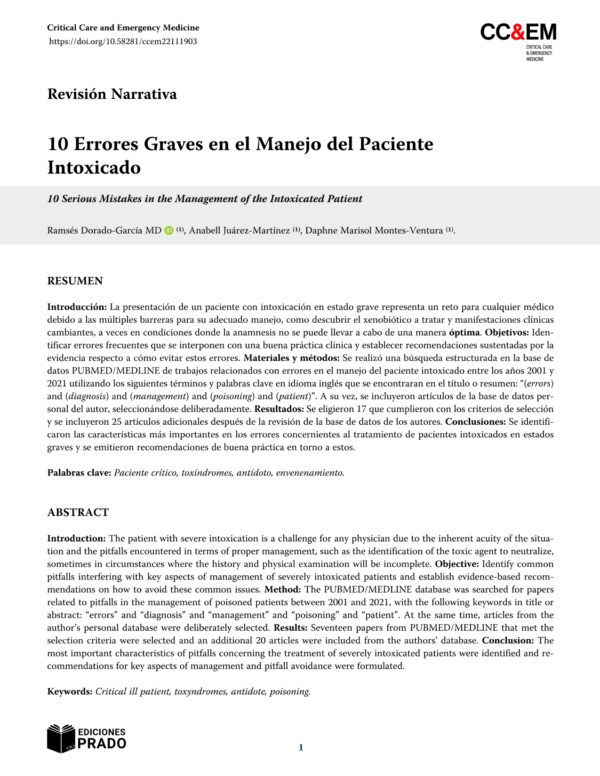

10 Errores Graves en el Manejo del Paciente Intoxicado.
CRITICAL CARE & EMERGENGY MEDICINE VOL. 1
10 Serious Mistakes in the Management of the Intoxicated Patient.
- 16 diciembre, 2022
- Revisión narrativa, Volumen 1
Ramsés Dorado-García

MD (1), Anabell Juárez-Martínez (1), Daphne Marisol Montes-Ventura (1).
Abstract
Introduction: The patient with severe intoxication is a challenge for any physician due to the inherent acuity of the situation and the pitfalls encountered in terms of proper management, such as the identification of the toxic agent to neutralize, sometimes in circumstances where the history and physical examination will be incomplete.
Objective: Identify common pitfalls interfering with key aspects of management of severely intoxicated patients and establish evidence-based recommendations on how to avoid these common issues.
Method: The PUBMED/MEDLINE database was searched for papers related to pitfalls in the management of poisoned patients between 2001 and 2021, with the following keywords in title or abstract: “errors” and “diagnosis” and “management” and “poisoning” and “patient”. At the same time, articles from the author’s personal database were deliberately selected.
Results: Seventeen papers from PUBMED/MEDLINE that met the selection criteria were selected and an additional 20 articles were included from the authors’ database.
Conclusion: The most important characteristics of pitfalls concerning the treatment of severely intoxicated patients were identified and recommendations for key aspects of management and pitfall avoidance were formulated
Resumen
Introducción: La presentación de un paciente con intoxicación en estado grave representa un reto para cualquier médico debido a las múltiples barreras para su adecuado manejo, como descubrir el xenobiótico a tratar y manifestaciones clínicas cambiantes, a veces en condiciones donde la anamnesis no se puede llevar a cabo de una manera óptima.
Objetivos: Identificar errores frecuentes que se interponen con una buena práctica clínica y establecer recomendaciones sustentadas por la evidencia respecto a cómo evitar estos errores.
Materiales y métodos: Se realizó una búsqueda estructurada en la base de datos PUBMED/MEDLINE de trabajos relacionados con errores en el manejo del paciente intoxicado entre los años 2001 y 2021 utilizando los siguientes términos y palabras clave en idioma inglés que se encontraran en el título o resumen: “(errors) and (diagnosis) and (management) and (poisoning) and (patient)”. A su vez, se incluyeron artículos de la base de datos personal del autor, seleccionándose deliberadamente.
Resultados: Se eligieron 17 que cumplieron con los criterios de selección y se incluyeron 25 artículos adicionales después de la revisión de la base de datos de los autores.
Conclusiones: Se identificaron las características más importantes en los errores concernientes al tratamiento de pacientes intoxicados en estados graves y se emitieron recomendaciones de buena práctica en torno a estos.
Keywords
Critical ill patient, toxyndromes, antidote, poisoning.
Biografias de autores
Ramsés Dorado-García
MD (1), Anabell Juárez-Martínez (1), Daphne Marisol Montes-Ventura (1).,
Referencias
- Cosgrove JF, Gascoigne AD. Inadequate assessment of the airway and ventilation in acute poisoning. A need for improved education? Resuscitation. 1999;40(3):161-4.
- Kolb JC, Galli RL. No gag rule for intubation. Ann Emerg Med. 1995;26(4):529-30.
- Duncan R, Thakore S. Decreased Glasgow Coma Scale score does not mandate endotracheal intubation in the emergency department. J Emerg Med. 2009;37(4):451-5.
- Marco L.A. Sivilotti, Flumazenil, Naloxone and “Coma Cocktail”, Br J Clin Pharmacol 2015, 428–436 / 81:3.
- Are vasopressors useful in toxin-induced cardiogenic shock?, Cassandra A. Skooga and Kristin M. Engebretsenb, clinical toxicology, 2017, VOL. 55, NO. 4, 285-304.
- Panorama epidemiológico de las intoxicaciones en México, Leticia Rodríguez Pimentel,* Amada Wilkins Gámiz,* Rocío Olvera Santamaría,* Rodolfo Silva Romo* Med Int Mex 2005; 21:123-32.
- QuickStats: Average Annual Number of Deaths and Death Rates from Unintentional, Non-Fire-Related Carbon Monoxide Poison- ing,*‚Ć by Sex and Age Group – United States, 1999-2010. Janu- ary 24, 2014 / 63(03);65. [cited 2014 Jun 5].
- Vere Borra, Bert Avau, Peter De Paepe, Philippe Vandekerckhove & Emmy De Buck (2019): Is placing a victim in the left lateral decubitus position an effective first aid intervention for acute oral poisoning? A systematic review, Clinical Toxicology
- Emergency Department Management of the Salicylate-Poisoned Patient Gerald F. O’Malley, DO Emerg Med Clin N Am 25 (2007) 333-346.
- An evidence based flowchart to guide the management of acute salicylate (aspirin) overdose P I Dargan, C I Wallace, A L Jones Emerg Med J 2002;19:206-209
- Extracorporeal Treatment for Salicylate Poisoning: Systematic Review and Recommendations From the EXTRIP Workgroup, David N. Juurlink, Annals of Emergency Medicine, Volume 66, no. 2 : August 2015.
- A Review of Acetaminophen Poisoning, Michael J. Hodgman, Crit Care Clin 28 (2012) 499-516
- Adult Toxicology in Critical Care, Part II: Specific Poisonings,Babak Mokhlesi, MD; Jerrold B. Leikin, MD; Patrick Murray, MD; and Thomas C. Corbridge, MD, FCCP (CHEST 2003; 123:897-922).
- An Evidence-Based Approach To Acetaminophen (Paracetamol, APAP) Overdose September 2010 Volume 12, Number 9, Emergency Medicine Practice.
- Mofenson HC, Greensher J. The unknown poison. Pediatrics. 1974;54(3):336-42.
- Pediatric Toxicology Specialized Approach to the Poisoned Child Diane P. Calello, MDa,b,c,*, Fred M. Henretig, MD, Emerg Med Clin N Am 32 (2014) 29–52.
- Common Toxidromes and the Role of Extracorporeal Detoxification, Nikolas Harbord, Adv Chronic Kidney Dis. 2020;27(1):11-17.
- Montoya CMA. Introducción en Intoxicaciones y Envenenamientos. México, Intersistemas, 2002.
- Point-of-Care Ultrasonography, Christopher L. Moore, M.D., and Joshua A. Copel, M.D. N Engl J Med 2011;364:749-57.
- Emergency Medicine News August 2016, Vol. 38, No. 8, LIPPINCOTT, WILLIAMS & WILKINS.
- Ultrasound to evaluate effectiveness of hyperbaric oxygen therapy, Meghan B. Spyres1 • Eleanor Oakley2 • Kimberlie A. Graeme2 Intern Emerg Med (2017) 12:413-414.
- Sonographic signs of snakebite, R. VOHRA , 1 C. RANGAN , 2 and R. BENGIAMIN 3 Clinical Toxicology (2014), 52, 948–951
- Olson KR and Vohra R. Emergency Evaluation and Treatment. In: Olson KR, Anderson IB, Benowitz NL, et al. Poisoning and Drug Overdose, 7e. McGraw-Hill, 2012.
- Schwartz DT. Principles of Diagnostic Imaging. In: Nelson LS, Howland M, Lewin NA, Smith SW, Goldfrank LR, Hoffman RS. eds. Goldfrank’s Toxicologic Emergencies, 11e New York, NY: McGraw-Hill; . http://accesspharmacy.mhmedical.com.libproxy. lib.unc.edu/content.aspx?bookid=2569§ionid=210267722. Accessed March 11, 2020.
- O’Brien, R. P., McGeehan, P. A., Helmeczi, A. W., & Dula, D. J. (1986). Detectability of drug tablets and capsules by plain radiography. The American journal of emergency medicine, 4(4), 302-312.
- Everson, G. W., Oudjhane, K., Young, L. W., & Krenzelok, E. P. (1989). Effectiveness of abdominal radiographs in visualizing chewable iron supplements following overdose. The American journal of emergency medicine, 7(5), 459-463.
- Tillman, D. J., Ruggles, D. L., & Leikin, J. B. (1994). Radiopacity study of extended-release formulations using digitalized radiography. The American journal of emergency medicine, 12(3), 310-314.
- Rousset, P., Chaillot, P. F., Audureau, E., Rey-Salmon, C., Becour, B., Fitton, I., … & Revel, M. P. (2013). Detection of residual packets in cocaine body packers: low accuracy of abdominal radiography—a prospective study. European radiology, 23(8), 2146-2155.
- Dally, S., Garnier, R., & Bismuth, C. (1987). Diagnosis of chlorinated hydrocarbon poisoning by x ray examination. British journal of industrial medicine, 44(6), 424.
- Savitt, D. L., Hawkins, H. H., & Roberts, J. R. (1987). The radiopacity of ingested medications. Annals of emergency medicine, 16(3), 331-339.
- Flach, P. M., Ross, S. G., Ampanozi, G., Ebert, L., Germerott, T., Hatch, G. M., … & Patak, M. A. (2012). “Drug mules” as a radiological challenge: sensitivity and specificity in identifying internal cocaine in body packers, body pushers and body stuffers by computed tomography, plain radiography and Lodox. European journal of radiology, 81(10), 2518-2526.
- Rev. Colegio de Microb. Quim. Clin. Costa Rica, Volumen 21, No2, Abril – Junio, 2015 • ISSN: 2215-3713.
- Efficacy of urine alkalinization by oral administration of sodium bicarbonate: a prospective open-label trial Barak Cohen, MD a, Ido Laish, MD a, 1, Tal Brosh-Nissimov, MD a, Azik Hoffman, MD a, Lior H. Katz, MD a, Rony Braunstein, MSc, PhD b, Ram Sagi, MD a, Goldman Michael, MD American Journal of Emergency Medicine 31 (2013) 1703-1706.
- Barfod Ch et al. Abnormal vital signs are strong predictors for intensive care unit admission and in-hospital mortality in adults triaged inthe emergency department. Scan Jour of Trauma, res and Emerg Med2012 20:28.
- Benson B et al. Position paper update: gastric lavage for gastrointestinal descontamination. J Clín Toixcol (2013), 51,140-146.
- Intoxicaciones agudas. Bases para el tratamiento en un servicio de urgencias. Santiago Nogué Xarau. Unidad de Toxicología Clínica. Hospital Clínic. Barcelona. 2010.
- HAZMAT Guide for First Responders, By Michael L. Madigan, Copyright Year 2017.
- Thompson, T. M., Theobald, J., Lu, J., & Erickson, T. B. (2014). The general approach to the poisoned patient. Disease-aMonth, 60(11), 509–524.
- Mokhlesi, B., Leiken, J. B., Murray, P., & Corbridge, T. C. (2003). Adult Toxicology in Critical Care*. Chest, 123(2), 577-592.
- Stoecker, W. V., Vetter, R. S., & Dyer, J. A. (2017). NOT RECLUSE—A Mnemonic Device to Avoid False Diagnoses of Brown Recluse Spider Bites. JAMA Dermatology, 153(5), 377.
- Corcoran, G., Chan, B., & Chiew, A. (2016). Use and knowledge of single dose activated charcoal: A survey of Australian doctors. Emergency Medicine Australasia, 28(5), 578-585.
- Cooper GM, Le Couteur DG, Richardson D, et al. A randomized clinical trial of activated charcoal for the routine management of oral drug overdose. QJM. 2005;98:655-660.
How to Cite / Como citar
Licencia
© 2025 Critical Care & Emergency Medicine by Ediciones Prado. This work is licensed under a Creative Commons Attribution 4.0 International License (CC BY 4.0) .
The copyrights of the articles published in Critical Care & Emergency Medicine belong to Ediciones Prado. The contents of the articles that appear in the Journal are exclusively the responsibility of the authors and do not necessarily reflect the opinions of the Editorial Committee of the Journal. It is allowed to reproduce the material published in Critical Care & Emergency Medicine without prior authorization for non-commercial use.